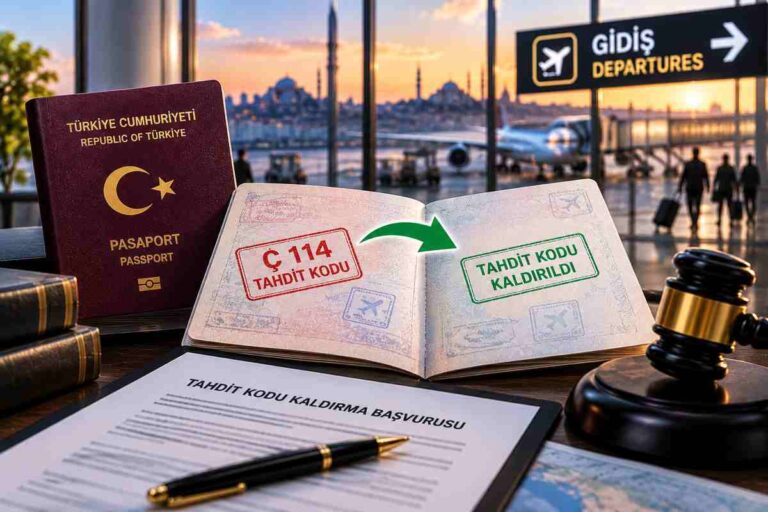
Deportation Lawyer in Turkey: Deportation Appeal & Removal Center Lawyer 2026

A deportation lawyer in Turkey can assist foreign nationals who have received a deportation decision, are being held in a removal center, face administrative detention, or have been prohibited from entering Turkey.
Deportation proceedings in Turkey are governed primarily by Law No. 6458 on Foreigners and International Protection. One of the most important points for a foreign national facing deportation is that the time available to challenge a deportation decision is extremely short.
Under Article 53 of Law No. 6458, a deportation decision may generally be challenged before the competent Administrative Court within 7 days from notification of the decision.
For this reason, a foreign national who has received a deportation order should first determine exactly when the decision was formally served and whether there are other decisions concerning administrative detention, an entry ban or restriction codes.
This guide explains what a deportation lawyer in Turkey can do, how to appeal a deportation order, what happens when a foreigner is detained in a removal center, how administrative detention can be challenged, and how entry bans and restriction codes may affect the case.
- Main legislation: Law No. 6458 on Foreigners and International Protection.
- Deportation decision: Governed primarily by Articles 52–55.
- Authority: Deportation decisions are issued by the governorates.
- Deadline to challenge: Generally 7 days from notification.
- Court: Administrative Court.
- Removal during proceedings: Subject to the foreigner’s consent, a foreigner is generally not removed during the statutory filing period or while a timely court challenge is pending.
- Administrative detention: Challenged separately before the Judge of the Criminal Court of Peace.
- Entry ban: A separate administrative measure and does not automatically disappear merely because detention ends.
- Restriction code: May require a separate legal assessment or challenge.
What Is Deportation in Turkey?
Deportation, legally referred to as removal under Turkish immigration law, is an administrative procedure through which a foreign national may be required to leave Turkey.
The deportation procedure is primarily regulated by Articles 52 to 60 of Law No. 6458 on Foreigners and International Protection.
A deportation decision is not the same as a criminal court judgment. It is an administrative decision issued within the framework of immigration law.
According to Article 53 of Law No. 6458, deportation decisions are issued by the governorates either upon the instruction of the Presidency of Migration Management or ex officio.
The official English version of the Law on Foreigners and International Protection is available through the Presidency of Migration Management .
What Does a Deportation Lawyer in Turkey Do?
A deportation lawyer in Turkey examines the administrative decisions issued against the foreign national and determines which legal remedies are available.
A deportation case may involve several different administrative measures at the same time. Therefore, simply filing a petition against “deportation” may not be sufficient.
A lawyer may need to examine:
- the deportation decision,
- the date on which the decision was served,
- the administrative detention decision,
- the foreigner’s location and removal center,
- the legal grounds for deportation,
- any entry ban,
- restriction or “tahdit” codes,
- residence permit history,
- visa violations,
- family ties in Turkey,
- medical circumstances,
- international protection issues, and
- the risk the foreigner may face if returned to another country.
Depending on the circumstances, a deportation lawyer may file an annulment action before the Administrative Court and separately challenge administrative detention before the competent Judge of the Criminal Court of Peace.
Important: A deportation decision, administrative detention, an entry ban and a restriction code are not the same legal measure. A foreign national may need to challenge more than one decision.
Who Can Be Deported from Turkey?
Article 54 of Law No. 6458 sets out the categories of foreign nationals in respect of whom a deportation decision may be issued.
Depending on the circumstances, these may include foreigners who:
- fall within the relevant deportation provisions following criminal proceedings,
- use false information or forged documents in immigration procedures,
- obtain their livelihood through illegitimate means during their stay in Turkey,
- are considered a threat to public order, public security or public health,
- overstay a visa or visa exemption beyond the statutory conditions,
- have their residence permit cancelled in circumstances covered by the law,
- work without a valid work permit where the statutory conditions apply,
- violate lawful entry or exit rules, or
- fall within other grounds specifically provided by Article 54.
Whether a particular Article 54 ground actually applies must be assessed on the facts of the individual case.
Who Cannot Be Deported from Turkey?
Even where a foreign national appears to fall within Article 54, Article 55 of Law No. 6458 provides important protection against deportation in certain circumstances.
A deportation decision should not be issued against persons covered by the statutory protection in Article 55.
These protections include, among others, foreigners:
- where there are serious indications that they would face the death penalty, torture, inhuman or degrading punishment or treatment in the country of return,
- for whom travel would be considered dangerous because of serious health problems, age or pregnancy,
- who are receiving treatment for a life-threatening illness and cannot receive the necessary treatment in the country to which they would be returned, subject to the statutory requirements,
- who are victims of human trafficking benefiting from the victim support process, and
- who are victims of serious psychological, physical or sexual violence until their treatment is completed, within the conditions prescribed by law.
Article 55 can be crucial. Medical reports, country-of-origin information and documents showing the foreigner’s individual circumstances may be important when arguing that removal would violate the statutory protections.
7-Day Deadline to Appeal a Deportation Decision in Turkey
One of the most important rules in Turkish deportation law is the 7-day deadline.
Under Article 53 of Law No. 6458, the foreign national, his or her legal representative, or lawyer may apply to the Administrative Court against a deportation decision within 7 days from the date on which the decision is notified.
The notification date is therefore extremely important.
Urgent: If you have just received a deportation decision, check the notification date immediately. Do not assume that the time limit starts when you entered the removal center, when the police first stopped you, or when a family member learned about the case.
What Happens If the 7-Day Deadline Is Missed?
Missing the statutory deadline can create serious procedural consequences and may prevent the ordinary annulment action against the deportation decision from being examined on its merits.
For this reason, the deportation document and notification records should be reviewed as soon as possible.
How to Appeal a Deportation Order in Turkey
A deportation decision may be challenged by filing an annulment action before the competent Administrative Court.
The case should address the specific legal and factual reasons why the deportation decision is unlawful.
Depending on the case, arguments may concern:
- incorrect application of Article 54,
- lack of sufficient factual grounds,
- incorrect or outdated information relied upon by the administration,
- family life in Turkey,
- the best interests of children,
- medical conditions,
- risk of torture or inhuman treatment,
- non-refoulement obligations,
- international protection circumstances,
- proportionality, or
- procedural defects in the administrative decision.
A generic petition is not necessarily sufficient. The arguments and supporting evidence should be tailored to the individual foreign national.
How Long Does the Administrative Court Take?
Under the current wording of Article 53, the application is subject to an expedited procedure. The statutory decision period is linked to the completion of the case file and, where applicable, interim decisions or a hearing.
The decision rendered under this special procedure is final.
This makes the initial court application particularly important because the ordinary appeal structure applicable to many other administrative cases does not operate in the same way here.
Does Filing a Deportation Case Stop Removal from Turkey?
Under Article 53 of Law No. 6458, subject to the foreigner’s consent, the foreign national is not removed during the period for bringing the court action or, where the judicial remedy has been used in time, until the proceedings are concluded.
This statutory protection is one of the most important reasons why the 7-day deadline must be taken seriously.
However: Stopping the physical removal from Turkey and obtaining release from a removal center are two different issues.
A deportation lawsuit does not automatically terminate an administrative detention decision. Administrative detention must be assessed and, where appropriate, challenged separately.
What Is a Removal Center in Turkey?
A removal center (geri gönderme merkezi) is a facility in which foreign nationals may be held under administrative detention in accordance with Turkish immigration law.
Foreigners subject to administrative detention may be transferred to removal centers in Istanbul or other provinces depending on the circumstances and available facilities.
Being held in a removal center does not automatically mean that deportation is inevitable.
The legality of the deportation decision and the legality of continued administrative detention are separate matters and may be reviewed through different legal procedures.
Can a Lawyer Visit a Foreigner in a Removal Center?
Yes. Turkish law provides for access to legal counsel for foreign nationals held in removal centers.
A lawyer may meet with the foreign national, examine available documents, determine whether a deportation decision has been served, identify relevant deadlines and evaluate whether an administrative detention challenge should be filed.
How Can Administrative Detention Be Challenged?
Administrative detention for the purpose of removal is primarily regulated under Article 57 of Law No. 6458.
The foreign national, legal representative or lawyer may apply to the competent Judge of the Criminal Court of Peace against the administrative detention decision.
The court challenge against administrative detention does not itself suspend detention while the application is being considered.
The Judge of the Criminal Court of Peace is required by law to review the application within a short statutory period.
If the conditions justifying administrative detention cease to exist or materially change, a further application may be made.
Can a Foreigner Be Released Before the Maximum Detention Period?
Yes. The statutory maximum period is not a mandatory detention period.
A foreign national may be released earlier where continued detention is no longer legally necessary or where the competent judicial authority determines that detention should not continue.
Are There Alternatives to Administrative Detention?
Yes. Article 57/A of Law No. 6458 provides alternatives to administrative detention.
Depending on the individual case, these may include measures such as residence at a specified address, reporting obligations and other alternatives provided by law.
Deportation Decision vs. Administrative Detention
| Issue | Deportation Decision | Administrative Detention |
|---|---|---|
| Purpose | Removal of the foreign national from Turkey | Detention under immigration law where statutory conditions exist |
| Main provision | Law No. 6458, Articles 52–55 | Law No. 6458, Article 57 |
| Court | Administrative Court | Judge of the Criminal Court of Peace |
| Key deadline | Generally 7 days from notification | Separate judicial review mechanism; not the same 7-day rule |
| Possible result | Annulment of deportation decision | Termination of administrative detention |
A foreign national may therefore need two separate court applications: one concerning deportation and another concerning administrative detention.
Deportation and Entry Bans in Turkey
A foreign national who is deported may also face a ban on entering Turkey.
Entry bans are primarily regulated by Article 9 of Law No. 6458.
An entry ban and a deportation decision are separate administrative measures. Successfully challenging one measure does not necessarily eliminate every other restriction in the immigration record.
Depending on the case, an entry ban may be challenged through an administrative application and/or an annulment action before the administrative courts.
For detailed information in Turkish, see our guide: Türkiye’ye Giriş Yasağı Nasıl Kaldırılır? Deport Kaldırma ve Meşruhatlı Vize 2026 .
How Long Can an Entry Ban Last?
Under Article 9 of Law No. 6458, an entry ban is generally imposed for a maximum of five years.
Where there is a serious threat to public order or public security, the period may be extended for an additional period within the statutory limits.
The exact duration and legal basis of the foreigner’s entry ban should be checked individually.
What Is a Restriction Code in Turkey?
Foreign nationals may also have a restriction code, commonly referred to in Turkish as a “tahdit kodu,” recorded in the immigration system.
Restriction codes may relate to different immigration, security or administrative circumstances.
Not all restriction codes have the same legal effect. The meaning of the specific code and the administrative decision based on that code must therefore be examined.
For a detailed guide, see: Restriction Codes in Turkey – Tahdit Kodları .
What Is the G-87 Restriction Code?
The G-87 restriction code appears in Turkish judicial decisions as a restriction record relating to general security assessments.
A G-87 record may have serious immigration consequences, including an entry ban or other administrative measures.
However, the existence of a G-87 restriction code is not the same as a criminal conviction.
Where a security-based restriction is challenged, the factual basis supporting the administrative assessment may become an important issue in judicial review.
For detailed information, see: G-87 Tahdit Kodu Nedir? Nasıl Kaldırılır? .
Can a Foreigner Be Deported If Married to a Turkish Citizen?
Marriage to a Turkish citizen does not automatically prevent deportation in every case.
However, a genuine and continuing family relationship may be highly relevant when assessing the legality and proportionality of a deportation decision.
The circumstances of a Turkish spouse, minor children and the impact of removal on family life may need to be presented to the court with supporting evidence.
Each case must be assessed individually. The mere existence of a marriage certificate should not be treated as an automatic guarantee against deportation.
What If the Foreigner Has a Turkish Child?
The existence of a Turkish citizen child or a child lawfully residing in Turkey may be important in the legal assessment, particularly in relation to family life and the best interests of the child.
The child’s age, dependency, living arrangements and relationship with the foreign parent may all be relevant.
Can a Foreigner with Serious Health Problems Be Deported?
Serious medical conditions can be highly relevant in deportation proceedings.
Article 55 provides protection in specified circumstances, including certain cases where travel would create a serious health risk or where a foreign national is receiving treatment for a life-threatening condition and the necessary treatment is unavailable in the country of return.
Medical claims should be supported with appropriate hospital reports, treatment records and other relevant evidence.
Simply stating that the foreign national is ill may not be sufficient. The medical condition, treatment needs, risks associated with travel and, where relevant, availability of treatment in the destination country should be documented.
Can Turkey Deport Someone Who Faces Torture or Persecution?
Turkish immigration law incorporates the principle of non-refoulement.
Article 4 of Law No. 6458 provides protection against sending a person to a place where there are serious grounds to believe that the person would face torture, inhuman or degrading punishment or treatment, or threats to life or freedom on protected grounds.
Article 55 also provides specific protection against deportation in relevant circumstances.
Where a foreign national claims that return would expose them to serious harm, the claim should be supported with evidence concerning both the person’s individual circumstances and current conditions in the proposed country of return.
What Documents Are Needed for a Deportation Case in Turkey?
The required documents vary depending on the circumstances. Useful documents may include:
- passport or foreign identity documents,
- the deportation decision,
- proof of the date of notification,
- administrative detention decision,
- entry-ban documents,
- documents relating to restriction codes,
- residence permit documents,
- marriage certificate,
- birth certificates of children,
- documents concerning Turkish citizen family members,
- medical reports,
- criminal investigation or court decisions,
- acquittal or non-prosecution decisions,
- international protection documents,
- evidence concerning the risk in the country of return, and
- previous immigration or court decisions.
Not every document is required in every case. Evidence should be selected according to the actual legal grounds being challenged.
What If You Have Already Been Deported from Turkey?
If the foreign national has already left or been removed from Turkey, the legal issue often shifts from stopping deportation to determining whether an entry ban or restriction code prevents the person from returning.
The following questions should be examined:
- Is there an active entry ban?
- How long is the ban?
- What was the reason for the ban?
- Is there a restriction code?
- Are there unpaid administrative fines?
- Is prior permission required for entry?
- Is there a legal basis to challenge the entry ban?
Depending on the case, an administrative application, annulment action or an appropriate visa procedure may be considered.
Can a Deportation Order Be Cancelled?
Yes. A deportation decision is an administrative act and is subject to judicial review.
If the Administrative Court finds that the deportation decision is unlawful, the decision may be annulled.
The outcome depends on the legal grounds of the individual case, the evidence relied upon by the administration and the evidence submitted by the foreign national.
No lawyer can legitimately guarantee that a deportation case will be successful.
How Long Does a Deportation Case Take in Turkey?
Deportation cases are subject to a special expedited procedure under Article 53 of Law No. 6458.
The current statutory framework provides for the case to be concluded within a short period after the file is considered complete or after the completion of any relevant interim decision or hearing.
Actual procedural timing can nevertheless be affected by service, requests for documents, interim orders and the circumstances of the individual case.
Do I Need a Deportation Lawyer in Turkey?
A foreign national is not legally required in every case to be represented by a lawyer in order to challenge a deportation decision.
However, deportation proceedings can involve several different legal issues simultaneously, including a 7-day court deadline, administrative detention, entry bans, restriction codes, family rights and non-refoulement claims.
For this reason, the first step should be to identify exactly which decisions have been issued and when they were notified.
Can a Lawyer Act If I Am Outside Turkey?
Depending on the legal procedure and the authority involved, many administrative and judicial steps may be carried out through an authorised lawyer even where the foreign national is outside Turkey.
The required power of attorney and consular/notarial formalities should be determined according to the particular procedure.
Frequently Asked Questions About Deportation in Turkey
1. How can I appeal a deportation order in Turkey?
A deportation decision may generally be challenged before the competent Administrative Court by filing an annulment action within the statutory period.
2. How many days do I have to appeal deportation in Turkey?
Under the current Article 53 framework, the ordinary deadline is 7 days from notification of the deportation decision.
3. Does the 7-day period start when I am detained?
Generally, the relevant period is tied to formal notification of the deportation decision, not simply the date on which the foreigner was first stopped or detained.
4. Will filing a deportation lawsuit stop my removal?
Subject to the foreigner’s consent, the law provides protection against removal during the statutory filing period and, where the judicial remedy is used, until the proceedings are concluded.
5. Does a deportation lawsuit release me from the removal center?
No. Deportation and administrative detention are separate legal measures. Administrative detention may need to be challenged separately before the Judge of the Criminal Court of Peace.
6. Can a lawyer get someone out of a removal center?
A lawyer can challenge the legality and continued necessity of administrative detention. Release depends on the legal circumstances and the decision of the competent authority or court.
7. Can I be deported if I am married to a Turkish citizen?
Marriage does not automatically prevent deportation, but genuine family life and the circumstances of the Turkish spouse may be relevant to the legal assessment.
8. Can I be deported if I have a Turkish child?
The existence and best interests of a child may be highly relevant, but having a Turkish child does not automatically cancel every deportation decision.
9. Can a sick person be deported from Turkey?
Article 55 provides protection in specified serious health circumstances. Medical evidence is important in determining whether those conditions are satisfied.
10. Can Turkey deport me to a country where I may be tortured?
Turkish law recognises the principle of non-refoulement. A person should not be returned where the statutory conditions concerning serious risks such as torture or inhuman treatment are established.
11. What is administrative detention in Turkey?
Administrative detention is an immigration-law measure under which a foreign national may be held in a removal center where the statutory conditions are satisfied.
12. How do I challenge administrative detention?
The foreign national, legal representative or lawyer may apply to the competent Judge of the Criminal Court of Peace.
13. Is deportation the same as an entry ban?
No. A deportation decision concerns removal from Turkey, while an entry ban concerns the person’s ability to enter Turkey again. They are separate administrative measures.
14. How long can an entry ban in Turkey last?
Under Article 9, an entry ban is generally subject to a maximum period of five years, with the possibility of an additional extension in serious public-order or public-security cases within statutory limits.
15. What is a tahdit code?
A tahdit or restriction code is an administrative record in the immigration system that may affect entry, stay or other immigration procedures. Different codes have different legal effects.
16. Can a G-87 code be removed?
Depending on the legal basis and facts, administrative and judicial remedies may be available against a G-87 restriction or related measures.
17. Can I return to Turkey after being deported?
This depends on whether an active entry ban, restriction code or other entry restriction remains. The current immigration records must be assessed.
18. Can I hire a Turkish lawyer while I am abroad?
Yes, depending on the procedure. A lawyer in Turkey may carry out many administrative and judicial procedures under an appropriate power of attorney.
19. Is a deportation lawyer mandatory?
Legal representation is not mandatory in every case, but the short filing period and interaction between deportation, detention and entry-ban procedures can make legal assistance important.
20. Can a deportation lawyer guarantee that my deportation will be cancelled?
No. The result depends on the facts, evidence, legal basis of the administrative decision and the court’s assessment. A legal outcome should never be guaranteed.
Related Legal Guides and Official Resources
Related Articles
- Appeal Against a Deportation Decision in Turkey – Detailed information about challenging a Turkish deportation decision.
- Turkey Entry Ban, Deport Removal and Special Visa – Information about entry bans and returning to Turkey.
- Restriction Codes in Turkey – Information about Turkish immigration restriction codes.
- How to Remove a Restriction Code in Turkey – Administrative and judicial remedies concerning restriction codes.
- G-87 Restriction Code – Legal consequences and removal of a G-87 general-security restriction.
- Foreigners Law in Turkey – General information concerning legal issues affecting foreign nationals.
Official Resources
Deportation Lawyer in Turkey – Legal Assistance
A deportation case can move quickly. If a foreign national has received a deportation decision, the first issue to establish is the date of notification, because the ordinary court deadline is only 7 days.
Where the foreign national is also being held in a removal center, administrative detention should be reviewed separately. Any entry ban or restriction code should also be identified because these measures may continue to affect the foreigner even after release from detention.
A properly prepared case therefore requires the deportation decision, detention status, immigration records and the foreigner’s individual circumstances to be considered together.
Contact a Deportation Lawyer in Turkey
If you have received a deportation order in Turkey, your relative is being held in a removal center, or you need legal assistance concerning administrative detention, an entry ban or a restriction code, you may contact our law office for an initial assessment of the case.
When contacting us on WhatsApp, please send your nationality, the date the deportation decision was served, the name of the removal center if applicable, and photographs or PDF copies of the documents you received.
Contact Us on WhatsAppLegal notice: This article is provided for general informational purposes only and does not constitute legal advice. Deportation, administrative detention, entry bans and restriction-code cases depend on the individual circumstances, the administrative decisions issued, notification dates and the legislation in force at the relevant time.